Research

Understanding how galaxies assemble from studies of their resolved stellar populations

Current themes

  • Probing the relationship between stellar disk and halo formation in both massive and low-mass spiral galaxies
  • Exploring the impact of dwarf-dwarf and dwarf-host interactions on low-mass galaxy evolution
  • Connecting interactions, star formation history, and galactic chemical evolution in dwarf galaxies
  • Disentangling the impact galaxy environment and cosmic reionization on ultra-faint dwarf galaxies

Overview

My work focuses on understanding how interactions between galaxies shape their evolutionary histories in the context of hierarchical assembly, the process of galaxy growth over cosmic time through mergers. Due to its proximity, our Local Group (LG) of galaxies provides a uniquely accessible laboratory for studying this process through detailed observations of individual stars. I use spectroscopic and photometric data of resolved stellar populations from ground- and space-based telescopes such as Keck, the Hubble Space Telescope (HST), the James Webb Space Telescope (JWST), and soon the Nancy Grace Roman Space Telescope, and from large spectroscopic surveys such as the Sloan Digital Sky Survey (SDSS) and the Subaru/Prime Focus Spectrograph (PFS) galactic archaeology survey, to address open questions on galaxy assembly with nearby galaxies.

My research has spanned every major component of disk galaxies, from the debris of mergers residing in galaxy outskirts, such as stellar halos, streams, and shells, to the stellar disks themselves, and the satellite dwarf galaxies that orbit them. Without comprehensive observational knowledge of how both disk and dwarf galaxies are impacted by interactions, we cannot fully understand the external versus secular processes driving the fundamental physics of galaxy evolution across small to large mass scales.

Please see below for a selection of recent research projects, and visit my ADS library for a complete list of publications. My current research focuses on HST data of nearby dwarf galaxies from the Scylla program, JWST observations from my approved Cycle 4 program, and collaborations with the SPLASH, TREX, and PFS galactic archaeology survey teams.

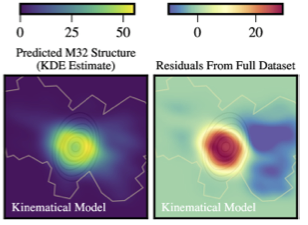
Predicted M32 structure and residuals from the full dataset
Escala et al. (2025)

Compact Elliptical Formation

What is the role of tidal interactions in the formation of rare compact ellipticals?

Compact ellipticals (cEs) are a rare class of low-mass galaxies with unusually high stellar densities, whose origins remain a long-standing puzzle. These galaxies may have formed through in-situ processes, through tidal stripping of more massive progenitors, or stripping of similar-mass progenitors that were compacted by intense tidal interactions and starbursts. As the only cE resolvable into individual stars, the satellite galaxy M32 provides a unique opportunity to test these formation scenarios. By modeling resolved stellar kinematics of M32's outskirts simultaneously with the background disk of M31 using DEIMOS data, we find the first kinematical evidence for the tidal distortion of M32, supporting a tidal origin for similar cEs. These kinematical constraints provide a new benchmark for models of M32's formation and its role in M31's merger history.

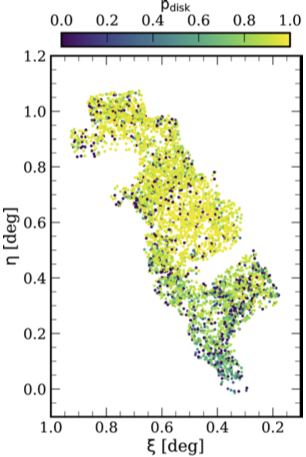
Spatial distribution of stars in the disk-halo region, colored by disk probability
Escala et al. (2023)

The Disk-Halo Connection

Do in-situ halo components originate from merger-driven disk heating in massive galaxies?

The stellar disks of massive galaxies encode their merger histories, as mergers can dynamically heat disk stars into the halo. In the Milky Way, the sole in-situ halo component is thought to have formed from such kinematically heated disk stars, but the prevalence of this formation channel to stellar halo formation in other massive galaxies is unknown. M31, which has the only other kinematically resolvable disk and halo of a massive galaxy, is an ideal testbed for quantifying the role of disk heating to halo formation, especially given its rich merger history. By combining PHAT photometry and Keck/DEIMOS spectroscopy from SPLASH, we identified a population of stars with disk-like metallicites, but halo-like kinematics, which are inconsistent with an accretion origin. This provides direct evidence for a heated disk component in M31's halo, suggesting that disk heating, possibly via mergers, may be a common formation channel for in-situ halo components in massive galaxies beyond our own.

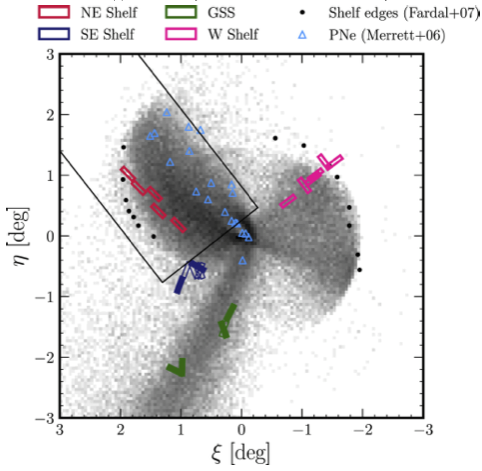
Map of M31's stellar halo and tidal features, including the northeast and southeast shelves, GSS, and west shelf
Escala et al. (2022)

Tidal Shell Formation

Are the tidal shells and giant stream in M31 consistent with a common origin in a single massive merger that shaped M31's evolution?

Merger debris, such as tidal streams and shells, provide a fossil record of the merger history of their host galaxies, as well as the properties of the destroyed progenitors. Whereas elongated stream features are common in massive galaxies, shell-like debris is comparatively rare, where their formation is thought to require a nearly radial merger orbit of a massive progentior. M31 hosts both a giant tidal stream and a system of tidal shells, which may have formed from the same recent, massive merger event that impacted M31's evolution, in stark contrast to the Milky Way's more ancient, quiescent merger history. Using archival SPLASH spectroscpy, we characterized the kinematics of M31's most prominent tidal shell, the NE shelf, for the first time, performing a comprehensive analysis of M31's full shell system and giant stream. This analysis presents strong chemodynamical evidence that all tidal features share a common origin in a single event, corroborated by agreement with tailored N-body simulations of the formation of the tidal system. This work provides constraints on the properties of the progenitor, M31's merger history, and suggests that significant late-time mergers may often reshape the evolution of massive disk galaxies.

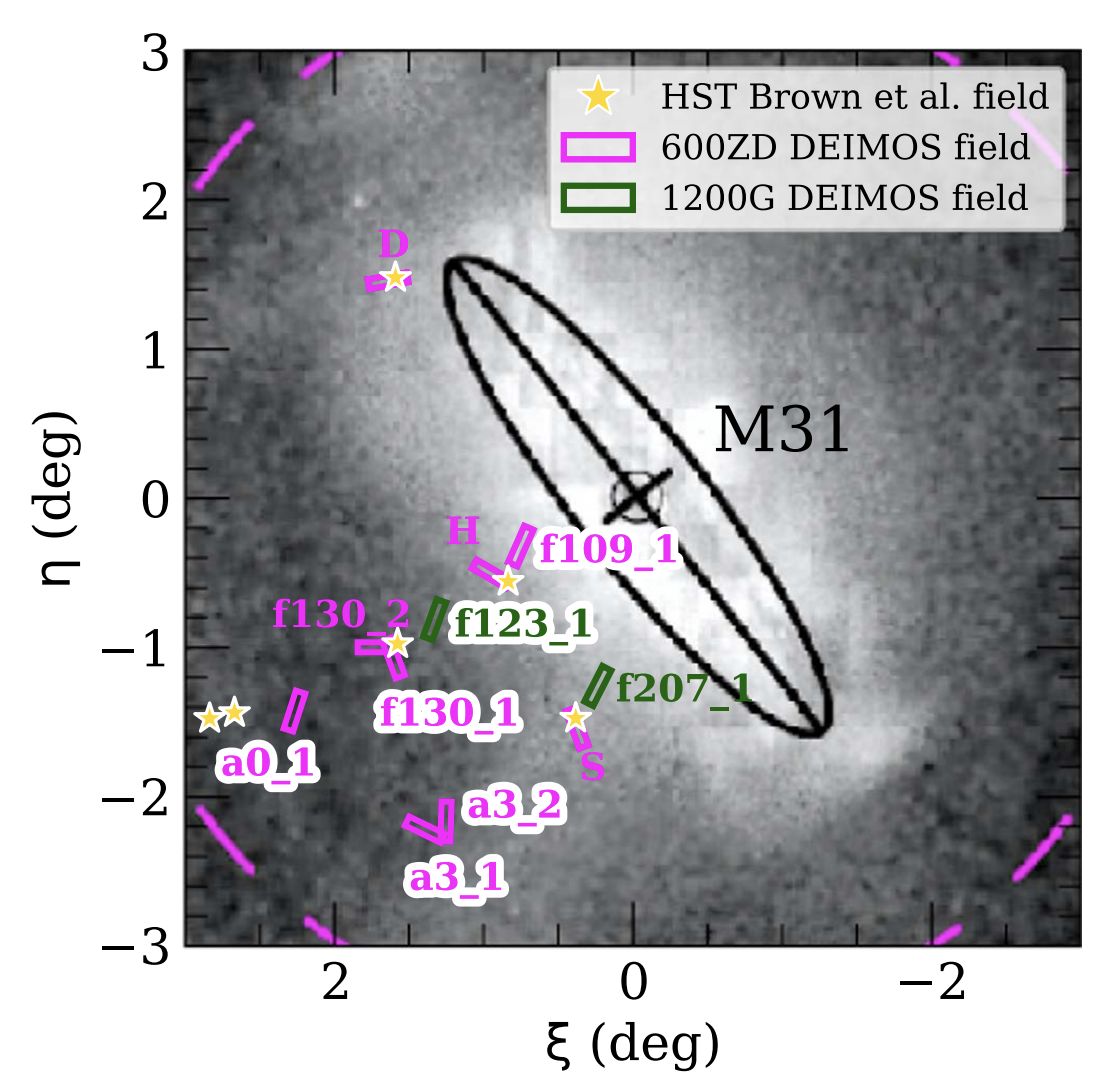
Hubble Space Telescope image of M31 and locations of spectroscopic fields
Escala et al. (2020b)

First Resolved Chemical Abundance Survey of an External Massive Disk Galaxy

Elemental Abundances in M31

Much of our understanding of the formation and evolution of massive disk galaxies is based on detailed chemical patterns of resolved stars in the Milky Way (MW). The MW, however, is only a sample of one, and it is unclear whether its merger history, and thus its history of star formation and chemical evolution, is representative of massive disk galaxies in general. To address this, we performed the first resolved chemical abundance survey of an external massive disk galaxy, M31, using deep Keck/DEIMOS spectroscopy for over 220 individual giant stars in M31's inner halo, tidal debris, outer disk, and dwarf galaxies (Gilbert et al. 2019, Escala et al. 2019, Escala et al. 2020a, Escala et al. 2020b, Kirby et al. 2020, Gilbert et al. 2020, Escala et al. 2021). We have also leveraged coadded abundances from shallow DEIMOS spectra to map the average chemical properties of M31's faint dwarf galaxies (Wojno et al. 2020, Cullinane et al. 2024) and halo (Wojno et al. 2023). The legacy of this work continues to inform our understanding of M31's assembly history, with JWST and PFS poised to provide the next generation of resolved chemical abundance measurements in M31.